Best Leopard Sightings in Jawai: Real Safari Photography Moments

Updated: Jul 24
No Cage. No Glass. No Barrier.
Just you, a jeep, and a leopard 30 feet away.
Most wildlife safaris show you nature from behind barriers—glass windows, fences, guides who keep you at a distance. You’re observing, not experiencing.
At Jawai, there are no barriers between you and the moment.

A leopard doesn’t care that you’re there. It stretches. Yawns. Checks its territory. Hunts. Rests. You’re not in its way—you’re just… there, witnessing its actual life unfold in real time.
These 10 moments are what make Jawai different. Not moments a guide manufactures for you. Moments that happen because wildlife isn’t contained in a box—it’s living.
1. The Golden Hour Silhouette (5:47 AM)
The sun hasn’t broken the horizon yet. The sky is amber bleeding into rose bleeding into indigo.
Your jeep moves slowly across the valley floor. Your guide’s eyes are on the granite cliffs ahead. Then—movement on the rocks.
A leopard emerges onto a flat stone outcrop, silhouetted against the dawn. For a moment, it’s just a perfect shape: the proud head, the muscular shoulders, the tail curved like a question mark.

The light catches it from behind, creating a halo you didn’t know was possible.
It walks the length of the rock—not hiding, not hunting, just moving—and disappears into shadow as the sun finally breaks.
The moment lasted 3 minutes.
You sit in silence, not wanting to speak, not wanting to break the spell.
Why only Jawai? Because there are no fences, no set routes, no “leopard zones.” This leopard was doing exactly what it does every morning—checking its territory. You got lucky enough to witness it.
2. The Yawn (7:15 AM)
A leopard on a boulder. Your jeep is parked 25 meters away. The guide whispers: “It’s comfortable. Not afraid.”
Then the leopard stretches its front legs, arches its back, and opens its mouth impossibly wide—a yawn that shows every tooth, every bit of power contained in the jaw of an apex predator.

For 4 seconds, you see it fully: the pink tongue, the massive canines, the casual ease of an animal that has nothing to fear in its own home.
Then the mouth closes. The leopard lies back down. Completely indifferent to the jeep, to you, to your gasping breath.
This moment breaks something in you—the wall between observer and observed. You’re not watching a “subject.” You’re watching a being exist in its own world, unconcerned with yours.
Why only Jawai? Because the leopard isn’t trained. Isn’t used to vehicles in a “safari zone.” It’s just a wild leopard, in its actual habitat, living its actual life.
3. The Dam Reflection (6:30 PM)
The Jawai Dam is perfectly still. The granite hills are turning purple. The light is that impossible copper-rose that happens for exactly 18 minutes before sunset.
A leopard emerges on a rock jutting into the water. It sees the water. It considers. It drinks.
And in the mirror-flat surface of the dam, you see not one leopard, but two—the real one and its reflection, identical and perfect.
Your photographer’s heart breaks a little. This shot will never look believable. The light is too good. The reflection is too perfect. The hills are too purple.
But it’s real. It’s happening. Right now.
The leopard finishes drinking, looks at its reflection for a moment—or so it seems—and pads slowly away, leaving concentric circles in the water that distort the reflection until it’s abstract again.
Why only Jawai? Because the dam isn’t a managed water hole. It’s an actual ecosystem. The leopard isn’t there because a guide brought it. It’s there because this is where water lives, and leopards need water.
4. The Territorial Patrol (8:00 AM)
Your guide says: “Watch. This leopard is checking its border.”
You follow a leopard walking a ridge line—not hunting, not hiding, just walking with absolute purpose. It stops at certain rocks, sniffs, marks. At other points, it seems to look across the valley to other hills, as if confirming: still mine.
This isn’t a 30-second moment. It’s a 20-minute experience of watching pure confidence. The leopard knows every inch of this land. It’s not exploring. It’s patrolling.
You realize you’re witnessing not a hunt, but a daily ritual as ordinary to the leopard as checking your email is to you. Except the leopard’s “email” is the scent of other animals, the state of its territory, the threats and food sources in its domain.
By watching this, you understand the leopard not as a killer, but as a manager of space.
Why only Jawai? Because these patrols happen in real time. In other safaris, you see leopards at specific moments—usually hunting or resting. At Jawai, you see the full spectrum of behavior because the leopard isn’t confined to a route or a time. It’s just… living.
5. The Alarm Call Response (9:30 AM)
Suddenly, every bird in a 200-meter radius erupts into alarm calls. Monkeys start screaming. The entire landscape goes from peaceful to chaos in 2 seconds.
Your guide says one word: “Leopard.”
You don’t see it. Not yet. But the landscape has announced its presence to every creature listening.
Then, movement—a flash of gold in the trees 80 meters away. A leopard, moving fast, heading toward a herd of chital deer that are now bolting in panic.
You don’t see the hunt. You don’t need to. You’re witnessing something most safari-goers never see: the ecosystem’s response to a predator’s presence. The invisible web of communication that keeps everyone in this landscape alive.
The alarm calls fade. The deer escape. The leopard disappears. The landscape, just as suddenly, falls quiet again.
You realize you just watched something that happens thousands of times a year here—something the Rabari know intimately, something the wildlife understands instinctively.
Why only Jawai? Because this is a wild system, not a managed one. The alarm calls are real. The panic is real. You’re not watching a choreographed moment; you’re witnessing the actual machinery of survival.
6. The Rock-to-Rock Leap (4:15 PM)
A leopard on one boulder. Another boulder 8 feet away, slightly lower.
The leopard gathers itself. Crouches. And launches itself across the gap—a moment of pure power and grace, all four paws leaving the ground simultaneously.
It lands on the far rock with perfect balance, as if gravity never applied to it.
Then it does it again, leaping from boulder to boulder across a series of rocks, moving upward toward the ridge line—not fleeing, not hunting, just traversing its terrain in the most direct way.

You watch this display of athletic grace and realize: this is what “leopard” means. This is why they survived when so many other predators didn’t. This is pure capability in motion.
The moment lasts 40 seconds. It feels eternal.
Why only Jawai? Because the leopard isn’t in an enclosure where it moves in predictable ways. It’s moving freely, doing what leopards do when no one’s watching—which, ironically, makes it all more visible.
7. The Kill Site Discovery (6:00 AM)
Your guide stops the jeep. Points to a rock outcrop. Says nothing.
As your eyes adjust, you see it: the remains of a wild boar. A kill from the previous night. Flies circling. Blood still wet on the stone.
Your guide explains: “Leopard made this kill maybe 8 hours ago. Already left to rest and digest. Will return tonight to feed again.”
You’re not watching a hunt. You’re witnessing evidence of one—the unglamorous reality of survival. This boar was alive 12 hours ago. A leopard killed it. The landscape continued.
This moment isn’t cinematic. It’s not beautiful. But it’s real—it’s the actual cost and reality of predation that we usually hide from in comfortable safaris.
Your guide points out the drag marks—how the leopard pulled the kill to the rocks. The specifics of the bite marks. The claw scratches where the boar struggled.
You’re reading a story written in blood and bone.
Why only Jawai? Because the leopards here actually hunt. They eat. They leave kill sites. In managed safaris, you see the leopard, but rarely the reality. Here, you see both.
8. The Cub Encounter (7:45 AM)
You see a small leopard emerge from the rocks.
Your heart stops.
A cub. Maybe 6 months old. Still young enough to be playful, old enough to be exploring independently.
It moves across an open area, alert but not alarmed by the jeep. Behind it, staying back about 40 meters, is the mother—watching, protecting, teaching.
The cub pounces on a piece of grass that moved in the wind. Misses. Tries again. The mother doesn’t interfere—she’s letting her cub learn to hunt, fail, try again.
For 8 minutes, you watch this intimate moment—a young leopard learning what it means to be a leopard. The mother watches you watching them. Neither of you moves.
Then the mother, satisfied with her cub’s distance from the jeep, turns and moves into the rocks. The cub follows, looking back once as if to say: I saw you.
This moment breaks you differently than others. It’s not about power or beauty. It’s about vulnerability, parenthood, the transmission of life across generations.
Why only Jawai? Because the cubs are wild. The mother is protecting them from real danger, not from tourists. You’re witnessing genuine parenting, not a moment choreographed for cameras.
9. The Night Prowl (We Don’t See This, But We Know It’s Happening)
Your guide says: “It’s 9 PM now. While we sit in camp around the fire, the leopard is moving. A leopard’s real life happens after dark.”
He points out the landscape you can see by vehicle spotlight (if available at your camp).
“That leopard we saw this morning? It’s awake now. Hunting. Moving across the rocks we walked this afternoon. We won’t see it, but it’s there. The Rabari herders in the village know it’s there. They’ve brought their cattle inside. They’re not afraid—they’re just… aware.”
This moment is the moment you realize: the leopard’s real life is invisible to us.
We see snapshots. The leopard lives the full film.
By understanding that, you understand Jawai’s true magic: it’s not about leopard sightings. It’s about understanding that leopards are always there, always living, and sometimes—if you’re lucky—you get to glimpse their world.
Why only Jawai? Because at Jawai, you don’t just see leopards. You understand that they’re part of the landscape in a way that goes beyond safari tourism. They’re not a product. They’re residents.
10. The Moment You Leave (3:00 PM on Your Last Day)
Your jeep pulls away from the camp for the last time. You’re heading toward the road, toward Udaipur or Ahmedabad or wherever home is.
You look back once.
The granite hills are still there. The dam is still there. The leopards are still there—somewhere in that landscape, doing what they’ve done for centuries.
And you realize: you didn’t come to Jawai to see a leopard.
You came to Jawai to understand something about the world that most places can’t teach you—that coexistence is possible. That humans and predators can share space. That culture and conservation can be the same thing.
The leopard was just the messenger.
This moment—leaving, understanding—is the most profound moment of the entire safari.
Why only Jawai? Because Jawai doesn’t just show you nature. It changes how you think about your relationship with it.
Why These Moments Only Happen at Jawai
No Fences = Real Behavior
A leopard in a fenced reserve behaves differently than a wild leopard. It knows the boundaries. It knows the routes tourists take. It knows to expect vehicles.
A Jawai leopard? It just is. It moves where it wants. Hunts where prey lives. Rests where it feels safe. You’re witnessing actual behavior, not managed performance.
No Crowds = Authentic Encounters
In major safari destinations, there can be 10+ jeeps around a single leopard. Everyone shouting. Cameras flashing. Guides jockeying for position.
At Jawai, you might be the only jeep. The leopard isn’t stressed. You can sit quietly. The moment can unfold naturally.
200 Years of Coexistence = Leopards Unbothered by Humans
The Rabari have lived alongside these leopards for generations. The leopards have learned that humans aren’t prey and aren’t (usually) threats. So they live their actual lives—not performance-mode lives.
This unbothered-ness changes everything. You’re not watching a wary predator. You’re watching a being comfortable in its home.
The Dam Creates Predictability
Leopards need water. The Jawai Dam means water is reliable. Which means leopards’ movement patterns are somewhat predictable. Not “safari route” predictable—but guide-can-read-the-signs predictable.
You’re not randomly driving hoping to see a leopard. Your guide knows where a leopard is likely to be based on patterns, tracks, territorial knowledge.
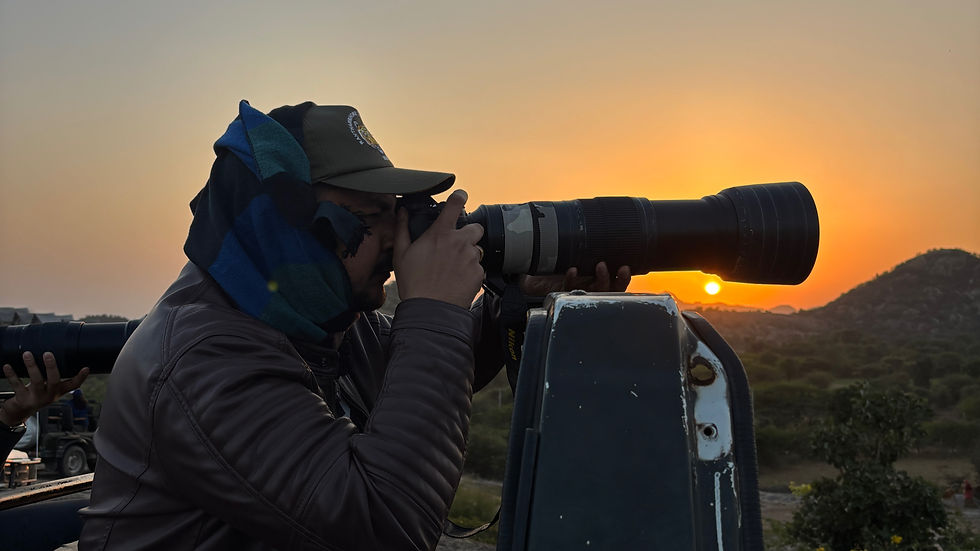
The Photography Angle: Why Photographers Book Jawai
If you’re a serious photographer, Jawai offers something no other safari does:
Time. You’re not fighting 10 other jeeps for a moment. You have space. You have time to compose. To wait for the light to shift. To capture multiple moments of the same animal.
Behavior. Because leopards are unbothered, they do full behaviors—hunting approaches, territorial patrols, complete kills. You get series shots, not single moments.
Light. The granite landscape creates incredible light reflections and shadows. The water of the dam creates mirrors. The hills create varied terrain for compositional depth.
Access. Your guide will position the jeep not for maximum distance, but for photographic opportunity—assuming it doesn’t stress the leopard.
When Can You Experience These Moments?
Peak Season (October–February)
Best probability: 70-80% chance of leopard sighting
Best light: Clear skies, dramatic shadows
Trade-off: More expensive, more tourists
Summer (May–June)
Best probability: 60-70% sighting
Best light: Pre-monsoon skies are dramatic—clouds, golden light, contrast
Trade-off: Hot, but far fewer tourists, better alone-time with leopards
Why it’s underrated: The light is actually more cinematic than peak season. Cloud cover creates depth.
Monsoon (July–August)
Best probability: 40-50% sighting
Best light: Green landscape, moody skies
Trade-off: Rain can cancel safaris, but landscape transformation is magical
Why it’s underrated: Fewer tourists, lower prices, and the dramatic weather creates incredible photo opportunities.
How to Maximize Your Chance of These Moments
Book 1–2 Days Minimum
One day isn’t enough. First day: leopard might be sleeping, might not cross your path. Second day: highest probability
Choose the Right Season
Peak season = more probability. Summer/monsoon = better experience if you get sighting.
Pick a Camp with Experienced Guides
Not all guides read leopard signs equally. Ask camps: “What’s your sighting rate?” Good camps will be honest. They know leopard behavior intimately.
Be Patient
The moment that seems like 10 seconds took a lifetime of evolutionary perfection to create. Sit quietly. Let the leopard exist without your expectation.
FAQ: The Moments You’re Really Asking About
Q: Will I actually see a leopard?
A: 60-80% probability depending on season. Not guaranteed, but highly likely with an experienced guide. The moments described above have all been documented and happen regularly.
Q: Can I photograph these moments?
A: Yes. Bring a telephoto lens (70-300mm minimum). Your guide will position the jeep to give you composition opportunities without stressing the leopard.
Q: Are these moments staged for tourists?
A: No. These are wild leopard behaviors documented thousands of times. You’re witnessing what actually happens at Jawai daily—not what’s arranged for your camera.
Q: What if I don’t see a leopard?
A: You’ll still see the landscape, the dam, the ecosystem. You’ll understand coexistence. The moment of not seeing the leopard is also a Jawai moment—understanding that leopards are always there, living their invisible lives.
Q: Can I see more than one leopard in a day?
A: Yes, possible. Jawai has 200+ leopards across the valley. If you’re there 2-3 days, multi-leopard sightings are common. One camp in particular has documented 5 leopard sightings in a single 2-day safari (though that’s exceptional).
The Moment That Lasts: Your Takeaway
These 10 moments aren’t a checklist. They’re not “things to see before you die.”
They’re 10 different ways to witness what Jawai teaches: that humans and wild things can coexist. That a leopard’s life is worth understanding. That the world still has places where boundaries exist not as walls, but as respect.
When you leave Jawai, you won’t just remember the moments you saw. You’ll remember what those moments taught you about what’s possible.
Next Steps: Book Your Moment
You’ve read about these moments. Now it’s time to create your own.
Every season at Jawai brings new moments. Every leopard creates its own story. Every day writes a different chapter.
🐆 Experience These Moments — Check Availability for May & June
Peak summer season is arriving. The light is about to turn dramatic. The crowds are about to disappear. This is your window.
Contact : The jawai yatra (92511 1091)
Want to Specialize in Photography?
📸 Book a Photography Safari at Jawai — Limited Jeep Seats
Some camps offer dedicated photography jeeps with guides trained specifically for photo ops. Smaller groups. More time. Better access.
Share Your Moment
Have you experienced Jawai? Share your moment in the comments. Tag us in your photos.
#JawaiLeopard #LeopardSafari #WildlifeMoments #JawaiRajasthan #CinematicTravel #IndiaSafari #thejwaiayatra
Book Your Jawai Wildlife Adventure With Us
Ready to experience the magic of Jawai's leopard country? We specialize in booking the finest accommodations for wildlife adventures in Jawai, taking the stress out of planning your perfect wilderness escape.
Why Book Through The Jawai Yatra:
✅ Expert Knowledge: We know every property in Jawai and can recommend the perfect match for your needs✅ Best Packages: Access to exclusive safari packages and competitive rates✅ Complete Arrangements: From luxury camps to eco-lodges, we book it all✅ Seamless Coordination: Safari bookings, cultural activities, and transfers—all handled✅ Personalized Service: Custom itineraries designed around your interests and budget✅ Local Insights: Benefit from our deep understanding of Jawai's wildlife patterns and seasons
Whether you're a wildlife photographer seeking the perfect leopard shot, a family wanting a safe and comfortable adventure, or a couple dreaming of a romantic wilderness escape, The Jawai Yatra makes it happen.
Get in Touch Today
📞 Call Us: +91 92511 10910 ✉️ Email: thejawaiyatra@gmail.com🌐 Website: www.thejawaiyatra.com
Don't leave your Jawai adventure to chance. Contact The Jawai Yatra today and let us create an unforgettable wildlife experience tailored perfectly to your dreams. From booking the ideal accommodation to arranging expert-guided safaris, we handle every detail so you can focus on the adventure of a lifetime.


Comments