Jawai June Safari: Why Wildlife Photographers Love Pre-Monsoon Leopard Season

Updated: Jul 9
The Light You’ve Been Waiting For: Discovering Jawai's Pre-Monsoon Magic
Just before the rains arrive, Jawai transforms into one of the most dramatic landscapes in India. The sky isn’t a clear blue. Instead, it’s turbulent—clouds build, light breaks through in shafts, and shadows deepen hour by hour.
A leopard perched on a rock isn’t backlit by the noon sun. It’s sidelit by the golden hour at 5 PM. The granite catches the light beautifully. The fur has texture, and the eyes have depth. This is what photographers spend all year chasing: light that tells a story. At Jawai in June, it happens every single day.

Not the perfect blue-sky light of peak season, but the dramatic, moody, cinema-grade light that makes ordinary moments extraordinary. For wildlife photographers, June at Jawai is the best-kept secret in India.
Why Pre-Monsoon Light Changes Everything (The Photography Why)
Most safari photographers book their trips from October to February, during peak season. They seek clear skies and optimal visibility. However, experienced photographers know that the best light isn’t necessarily the clearest light. It’s the most dramatic light.
The Pre-Monsoon Problem (That’s Actually An Advantage)
In June, the monsoon approaches. The atmosphere is heavy with moisture, and the weather is unstable. Clouds build daily. Standard photography advice often suggests avoiding clouds because they can kill light. But monsoon-adjacent clouds don’t kill light; they sculpt it.
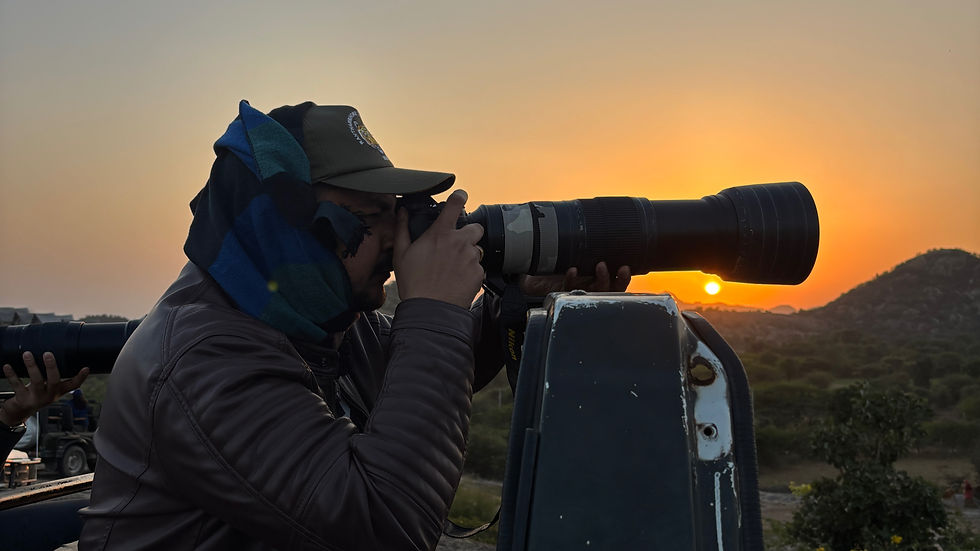
Directional Light: Clouds block direct overhead sun, forcing light to come from angles. This sidelight and backlight create three-dimensional light. Such light adds texture, depth, and dimension that flat overhead sun cannot provide.
Dynamic Light: Clouds move, and light shifts. The same scene can look different every ten minutes. You can capture multiple compositions from one location as the light evolves. The contrast between golden light and dark clouds creates dramatic images.
Color Saturation: Overcast conditions increase color saturation. Fur appears richer, eyes look deeper, and vegetation appears more vibrant.
Time Windows: With clouds, golden hour isn’t just from 5 to 6:30 PM. It can be intermittent throughout the afternoon as cloud cover shifts. This means more usable light throughout the day.
Mood: A leopard in harsh noon light looks like a leopard. But a leopard in pre-monsoon golden light looks like a story. This is why experienced photographers prefer June at Jawai over October at Ranthambore.
The Specific Magic Of June At Jawai (What You’ll Actually See)
Morning Light (5:30 AM – 8:00 AM)
You’re in a jeep, and the landscape is still cool from the night. Mist rises from the dam in certain places. As the sun breaks the horizon, it hits the granite cliffs at a 15-degree angle. Every texture is visible, and every rock casts a shadow. The landscape appears three-dimensional.
A leopard emerges on a cliff, illuminated by directional golden light that makes its coat glow.
Your shot: Silhouette against golden light, with the landscape visible in detail behind. Use a 70-300mm lens, shutter speed 1/1000, f/5.6, ISO 400. You get about 20 minutes of this light quality before it moves higher.
Midday (8:00 AM – 12:00 PM)
Normally, midday is considered dead for wildlife photography due to harsh light and poor conditions. But in June, clouds often build by 10 AM. Suddenly, you have soft, directional light. There are no shadows under the eyes, and color saturation improves.
Your shot: A leopard on a rock, defined by cloudy-bright light, with full facial detail visible. Use a 300mm lens, shutter speed 1/500, f/8, ISO 200. You’re photographing in conditions that would be useless in October.
Afternoon/Golden Hour (3:30 PM – 6:30 PM)
This is the star of pre-monsoon photography. The light is golden, but it’s not the flat golden of sunset. It streams through dramatic clouds, creating spotlights, shadows, and dynamic contrast.
A leopard in this light doesn’t need a dramatic pose; the light itself is dramatic.
Your shot: A leopard in the landscape, with golden sidelight and dark clouds behind creating contrast. Use a 24-70mm lens to show context, shutter speed 1/500, f/4, ISO 320. This is the light that wins photography awards.
Evening (6:30 PM – 7:30 PM)
Clouds turn purple, orange, and red. The sky becomes a story in itself. Even if the leopard has gone, you can capture landscape shots that rival any travel photography.
Your shot: A landscape-focused image with a dramatic sky, and a leopard silhouette is optional. Use a wide lens, shutter speed 1/250, f/8, ISO 100. The sky alone is worth the trip.
The Gear You Actually Need (Not The Gear You Think)
Photographers often overthink their gear. At Jawai, you don’t need the best camera. You need the right lens and a solid understanding of light.

The Essential Lens
A 70-300mm telephoto zoom lens (or 100-400mm if you have it) is essential. Here’s why:
70-150mm range captures portraits (head and shoulders).
200-250mm captures half-body and environmental portraits (leopard in landscape).
300mm captures full body and running shots.
Zoom gives flexibility without switching lenses, which can disrupt the safari flow.
Your best shot at Jawai will likely be at 200-250mm, not maximum zoom. You’re not shooting from far away; the leopard is usually 30-50 meters away. You want context, not extreme magnification.
Secondary Lens
A 24-70mm wide lens is also useful for:
Landscape shots (if the leopard doesn’t appear, you still have content).
Environmental portraits (leopard in landscape context).
Sunset and dramatic sky shots.
Camp documentation.
Settings That Work
Golden hour: Shutter 1/500-1/1000, f/4-f/5.6, ISO 400-800.
Midday cloudy: Shutter 1/500, f/8, ISO 200-400.
Evening: Shutter 1/250, f/5.6, ISO 100-200.
These are starting points. Adjust based on actual light and your camera’s capabilities.
What NOT To Worry About
Having a full-frame camera (crop sensors work great).
Having the latest gear (5-year-old equipment is fine).
Having multiple lenses (one good zoom is better than three mediocre lenses).
Having fast glass (f/2.8 is overkill in Jawai light; f/4-f/5.6 is ideal).
The light at Jawai is so good that gear matters less than composition.
The Photography Composition Tips (Specific To Jawai)
Rule 1: Use The Granite As Framing
The granite cliffs at Jawai are massive compositional elements. Don’t shoot the leopard isolated against the sky. Instead, frame it with granite.
Composition: Leopard center-right, large granite formation left, sky above. This creates visual weight and interest.
Why it works: The granite tells the story: “this is Jawai.” It’s not just a generic leopard; it’s a Jawai leopard.
Rule 2: Silhouette When The Light Is Dramatic
When golden or purple light is extreme, shoot silhouettes. They can be more powerful than detail shots in dramatic light.
Composition: Leopard dark against a golden or purple sky. Simple and iconic.
Why it works: Your eye goes straight to the shape. The drama of the light isn’t competing with fur texture; it’s the center of the image.
Rule 3: Include The Landscape For Context
Half of your shots should show the leopard in its landscape. This tells viewers where the coexistence is happening.
Composition: Leopard visible but not dominant. Landscape, dam, and hills are equally important. Use a wide lens (24-70mm).
Why it works: Generic leopard portraits could be from any safari. Leopard-in-Jawai landscape shots are unique and make for great portfolio pieces.
Rule 4: Watch For The “Moment” (Not Just The Pose)
The best shots happen when the leopard is doing something: stretching, yawning, transitioning between rocks, or looking toward the camera.
Composition: Capture the movement. The moment, not just the static pose.
Why it works: Movement equals emotion. A yawning leopard conveys power, while a stretching leopard conveys ease. A leopard looking at you conveys connection.
Rule 5: Expect Imperfection—And Use It
Pre-monsoon light is unpredictable. Clouds shift rapidly, and you won’t always get perfect conditions.

Composition: Use the imperfection. Dark foreground plus bright background. Partial sun plus shadow. These “flaws” create drama.
Why it works: Perfect light can be boring. Dramatic light is memorable.
The June-Specific Photography Advantages
Fewer Photographers (Same Wildlife)
In October, there can be 10+ jeeps around a leopard. In June, there are usually only 1-2 jeeps.
Photography advantage: You get clean shots without other vehicles in the frame.
Smaller Group Sizes
Photography-specific safaris at Jawai keep groups small (2-4 photographers max per jeep).
Photography advantage: Flexible jeep positioning, no fighting for angles, and guides focus on light and composition.
Predictable Weather Patterns
June storms are predictable. They typically arrive in the afternoon, while morning light remains golden-hour quality.
Photography advantage: You know when you’ll have good light and can plan compositions around the forecast.
Longer Safari Flexibility
Some camps extend pre-monsoon safaris because “everything is golden light.” You might get a 4-5 hour safari instead of the usual 3-4.
Photography advantage: More time in the field means more light variations and more chances to capture great images.
Lower Prices
June is considered off-season, so photography packages are 30-40% cheaper than in October.
Photography advantage: You get premium light at budget pricing.
The Pre-Monsoon Challenge (And How To Manage It)
Let’s be honest: pre-monsoon has downsides for photographers.
Challenge 1: Leopard Behavior Changes
Before the monsoon, leopards often shift territory. Sightings might drop to 50-60% instead of the usual 70-80%.
Solution: Book 4+ days instead of 2-3. More days equal a higher probability of sightings. Request a “photography-focused” safari that adjusts timing to light windows, not just leopard-finding.
Challenge 2: Weather Unpredictability
Rain can cancel afternoon safaris, and visibility can shift rapidly.
Solution: Embrace the unpredictability. Rain creates moody landscapes, and partial visibility can add mystery. These conditions present unique composition opportunities.
Challenge 3: Heat Fatigue
June can be hot (38-42°C until June 20, then 35-38°C). You may feel exhausted by noon.
Solution: Opt for an early morning safari (5:30-8:30 AM) and rest in the afternoon. Don’t push yourself; quality photography requires energy.
FAQ: Photographer-Specific Questions
Q: What camera settings should I use?
A: Start with shutter 1/500-1/1000, f/5.6, ISO 400-800. Adjust based on actual light. Shoot in aperture priority mode and let the camera handle shutter speed. Focus on composition and light.
Q: Should I use a polarizing filter?
A: Yes. Pre-monsoon light benefits from polarization. It deepens sky color, reduces glare, and increases saturation. Bring a circular polarizer.
Q: What if I don’t see a leopard?
A: You’ll still have landscape shots, sky shots, and possibly other wildlife. The June landscape at Jawai is incredible. You won’t leave empty-handed.
Q: Can I bring a drone?
A: Check with the camp. Most don’t allow drones due to wildlife disturbance, but some have designated times or zones. Ask in advance.
Q: How many shots will I take per day?
A: Expect 300-500 shots per 4-hour safari. That’s about trigger discipline, not spray-and-pray. You’ll likely have 100-150 keepers from a full day.
Q: Is pre-monsoon better than peak season for photography?
A: It’s different, not objectively better. Peak season offers clarity and abundance (more leopard sightings). Pre-monsoon offers drama and light. For portfolio work, pre-monsoon wins. For quantity, peak season wins.
Q: Can I book a private jeep for photography?
A: Yes. Most camps offer “photography-specific safaris” with dedicated guides trained for composition. It may cost more, but it’s worth it for serious photographers.
Q: What’s the best time of day to photograph?
A: Golden hour (5-6:30 PM) and midday with cloud cover (10 AM-12 PM) are ideal. Morning light is good but predictable. The afternoon is when the drama happens.
The Photographer’s Journey (What You’ll Actually Experience)
Day 1 Arrival:
You arrive mid-afternoon. Your guide is someone trained in composition and light, not just animal-finding. They ask, “What kind of shots are you after?” They actually listen.
Day 2 Morning:
At 5:30 AM, the light is golden. Your guide positions the jeep for sidelight on a leopard. You’re not fighting other jeeps. You have time to compose. Your guide waits and doesn’t rush you. You take 50 shots of the same leopard from different angles as the light evolves. This is the opposite of a typical safari, where you might only get a 30-second moment before moving on.
Day 2 Afternoon:
Dramatic clouds roll in. Your guide says, “The light’s about to get incredible.” You move to a ridge overlooking the dam. The sky is stormy, and you photograph the landscape. The leopard becomes secondary; the light is the subject.
Day 3:
By now, you’ve learned the landscape. You know what light to expect. Your guide understands your vision. You’re not just photographing animals; you’re capturing moments. There’s a difference.
Day 4:
You leave with over 1,500 shots. Half of them are portfolio quality. You have a series (morning light, midday drama, evening silhouettes). This isn’t just a vacation; this is a working trip.
Post-Safari: Processing Your Jawai Photographs
The magic doesn’t end when you leave. Pre-monsoon light creates RAW files that are incredibly malleable in post-processing. Here’s what to do:
Embrace the drama: Don’t flatten pre-monsoon drama in editing. Increase contrast slightly to let the moody sky remain moody.
Increase vibrance, not saturation: Pre-monsoon light is naturally saturated. Boost vibrance (+20-30) to bring color alive without looking processed.
Add subtle clarity: Increase clarity (+15-25) to make granite texture and fur detail pop.
Don’t overdo shadows: Resist the urge to brighten shadows. The darkness is intentional and part of the drama.
Correct for the atmosphere: Pre-monsoon atmospheric haze is real. A slight clarity/dehaze bump helps, but don’t overdo it. Haze adds mood.
When To Book Pre-Monsoon (Timing Strategy)
Best window: June 10-25
Why June 10-25:
June 1-10: Monsoon arriving, light unstable.
June 10-25: Pre-monsoon light perfected, monsoon not yet arrived.
June 26-30: Monsoon beginning, conditions degrade.
Booking timeline:
Book 4-6 weeks ahead for flexibility.
Book photography-specific packages (not standard safaris).
Request a “light-focused” guide experience.
Leopard sighting reality:
June 10-20: 60-70% sighting probability.
June 21-25: 50-60% sighting probability (monsoon approaching).
These numbers aren’t peak season levels, but the light compensates.
Next Steps: Book Your Photography Safari
You know what you want. You’ve seen the light and understand the composition opportunities. Now, make it happen.
📷 Book a Photography Safari at Jawai This June — Limited Jeep Seats
When you contact a camp, be specific:
“I’m a wildlife photographer booking a photography safari. I want a guide trained in composition and light, not just animal-tracking. I’m interested in pre-monsoon dramatic light. What photography-specific packages do you offer?”
The response will tell you if they understand what serious photographers need.
For Photography Groups:
👥 Organize a Photography Group Tour — Discounts for 4+ Photographers
If you have 3+ photographer friends interested, we can organize a dedicated group tour with:
Photography-trained guide.
Flexible timing for light opportunities.
Shared jeep (smaller group).
Group rate discount (20-30%).
Evening photography workshops at camp.
For Technical Help:
📧 Get Our Photography Guide: Gear + Settings + Composition Tips
We’ve created a detailed guide for Jawai photographers, including:
Camera settings by light condition.
Lens recommendations.
Composition frameworks.
Post-processing workflow.
Gear list (what to bring, what to leave).
Join our mailing list and get it free.
Why June Is The Secret Photography Season
Most photographers book in October, seeking clear skies and abundant leopards. However, experienced photographers know that the best light isn’t the clearest light; it’s the most dramatic light.
June at Jawai offers drama that you won’t find in October. You’ll experience cloud texture, golden hour depth, and contrast that makes images pop. While leopard sightings may be slightly lower, when you do capture a shot, it’s in light that transforms it from a “nice wildlife photo” to a “portfolio image.”
This is why photographers are secretly booking June at Jawai. And now you know why too.
Why Book Through The Jawai Yatra:
✅ Expert Knowledge: We know every property in Jawai and can recommend the perfect match for your needs.
✅ Best Packages: Access to exclusive safari packages and competitive rates.
✅ Complete Arrangements: From luxury camps to eco-lodges, we book it all.
✅ Seamless Coordination: Safari bookings, cultural activities, and transfers—all handled.
✅ Personalized Service: Custom itineraries designed around your interests and budget.
✅ Local Insights: Benefit from our deep understanding of Jawai's wildlife patterns and seasons.
Whether you're a wildlife photographer seeking the perfect leopard shot, a family wanting a safe and comfortable adventure, or a couple dreaming of a romantic wilderness escape, The Jawai Yatra makes it happen.
📞 Call Us: +91 92511 10910 ✉️ Email: thejawaiyatra@gmail.com 🌐 Website: www.thejawaiyatra.com
Don't leave your Jawai adventure to chance. Contact The Jawai Yatra today and let us create an unforgettable wildlife experience tailored perfectly to your dreams. From booking the ideal accommodation to arranging expert-guided safaris, we handle every detail so you can focus on the adventure of a lifetime.
Your journey to Jawai's leopard hills begins with one call. Reach out now and discover where wild India meets exceptional hospitality.


Comments